
When nurses look for opportunities overseas, salary and location are usually the first things that come to mind. But there is another important question worth asking:
Is the hospital internationally accredited?
Hospital accreditation gives nurses a clearer idea of how seriously an organisation treats patient safety, clinical standards, governance, and continuous improvement. It does not mean every hospital experience will be perfect, but it is a useful sign that the hospital has gone through formal external assessment and is expected to meet recognised quality standards.
For nurses planning an international career, understanding these accreditations can help you choose workplaces that value safe practice, professional development, and high-quality patient care.
Why hospital accreditation matters
Accreditation is more than a badge on a hospital wall. It often reflects a hospital’s commitment to structured policies, measurable standards, staff training, clinical governance, and patient-centered care.
For nurses, this matters because accredited hospitals are more likely to have clear procedures, stronger quality systems, and a culture that supports safer clinical practice. In many overseas healthcare systems, accreditation also helps patients, regulators, and healthcare professionals identify organisations that are working toward internationally recognised standards.
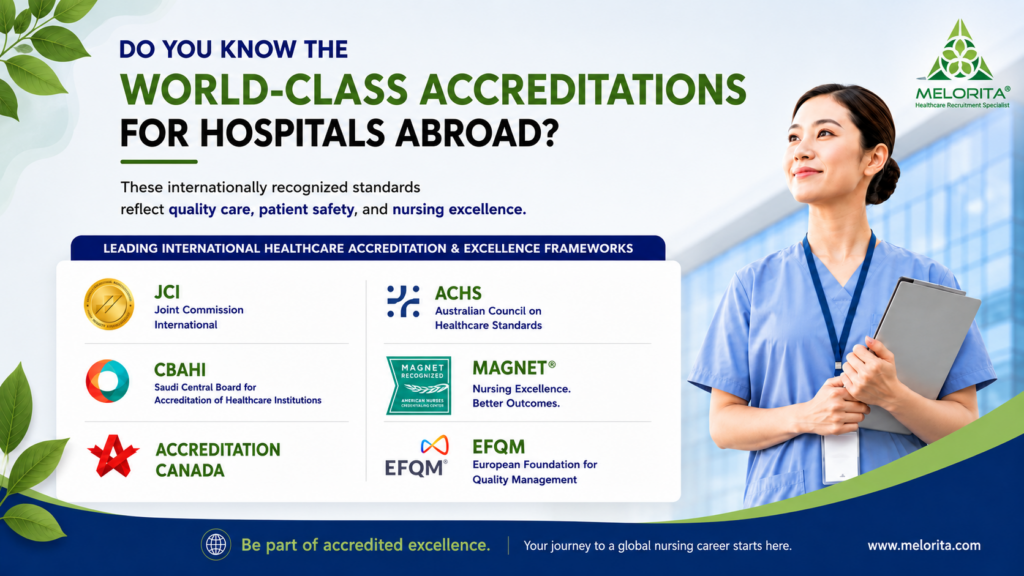
Key healthcare accreditations nurses may see abroad
JCI: Joint Commission International
JCI is one of the most widely recognised names in global healthcare accreditation. Its standards focus on safe, high-quality care and help healthcare organisations measure, assess, and improve performance. JCI accreditation also signals that a hospital has undergone an objective review of its quality and patient safety systems. ( Joint Commission International )
For nurses, JCI-accredited hospitals often place strong emphasis on documentation, patient identification, medication safety, infection prevention, communication, and continuous quality improvement.
CBAHI: Saudi Central Board for Accreditation of Healthcare Institutions
CBAHI is the official body authorised to grant accreditation certificates to healthcare facilities in Saudi Arabia. Its role includes setting healthcare quality and patient safety standards used to evaluate hospitals and other healthcare institutions in the Kingdom. ( portal.cbahi.gov.sa )
This accreditation is especially relevant for nurses considering opportunities in Saudi Arabia. It shows that the hospital is expected to meet local regulatory and quality requirements.
Accreditation Canada
Accreditation Canada works with healthcare organisations to help them meet national and global standards. Its programmes assess organisations against standards developed by bodies such as Health Standards Organization, ISO, and others. These standards are designed to support high-quality care for patients. ( Accreditation Canada )
For nurses, this often connects with patient-centred care, safety culture, leadership, service quality, and team-based improvement.
ACHS: Australian Council on Healthcare Standards
The Australian Council on Healthcare Standards is an independent, not-for-profit organisation focused on improving healthcare quality. ACHS and ACHS International support accreditation and quality improvement programmes for healthcare organisations in Australia and internationally. ( ACHS )
Nurses may encounter ACHS standards in hospitals that place strong emphasis on clinical governance, quality systems, patient-centred care, and ongoing improvement.
Magnet Recognition Program
The Magnet Recognition Program, run by the American Nurses Credentialing Center, is highly relevant to nurses because it focuses directly on nursing excellence. The programme recognises organisations where nursing leaders align nursing goals with better patient outcomes and provides a roadmap for nursing excellence. ( ANA )
For nurses, Magnet recognition can suggest a workplace culture that values professional development, nursing leadership, evidence-based practice, autonomy, and strong patient outcomes.
EFQM: European Foundation for Quality Management
EFQM is not limited to hospitals, but it is still relevant to healthcare organisations. The EFQM Model is a globally recognised management framework that helps organisations manage change and improve performance. ( EFQM )
In healthcare, this can support leadership, strategy, innovation, service improvement, and organisational excellence.
What this means for nurses planning to work overseas
Before accepting an overseas nursing role, it is worth researching the hospital’s accreditation status. You can ask recruiters, check the hospital website, or verify the accreditation directly through the relevant accreditation body.
A hospital’s accreditation can help you understand:
- Whether the hospital follows recognised quality and safety standards
- How seriously it approaches patient care and clinical governance
- Whether nursing excellence and professional development are part of its culture
- How prepared the organisation is for audits, reviews, and continuous improvement
- Whether the work environment may support safer and more structured practice
Accreditation should not be the only factor in your decision, but it is a strong starting point. It helps you look beyond the job title and salary package, and it gives you a better sense of the hospital’s professional standards.
Final thoughts
A global nursing career is not just about moving to another country. It is about choosing the right environment to grow, practise safely, and build long-term professional confidence.
Understanding hospital accreditations such as JCI, CBAHI, Accreditation Canada, ACHS, Magnet, and EFQM can help nurses make more informed decisions when exploring international opportunities.
When you know what these standards mean, you are not just looking for a job abroad. You are looking for a workplace that values quality care, patient safety, and nursing excellence.
Source credits
JCI: Joint Commission International
CBAHI: Saudi Central Board for Accreditation of Healthcare Institutions. (
portal.cbahi.gov.sa
)
Accreditation Canada
ACHS: Australian Council on Healthcare Standards. (
ACHS
)
Magnet Recognition Program:
American Nurses Credentialing Center
EFQM Model (
EFQM
)